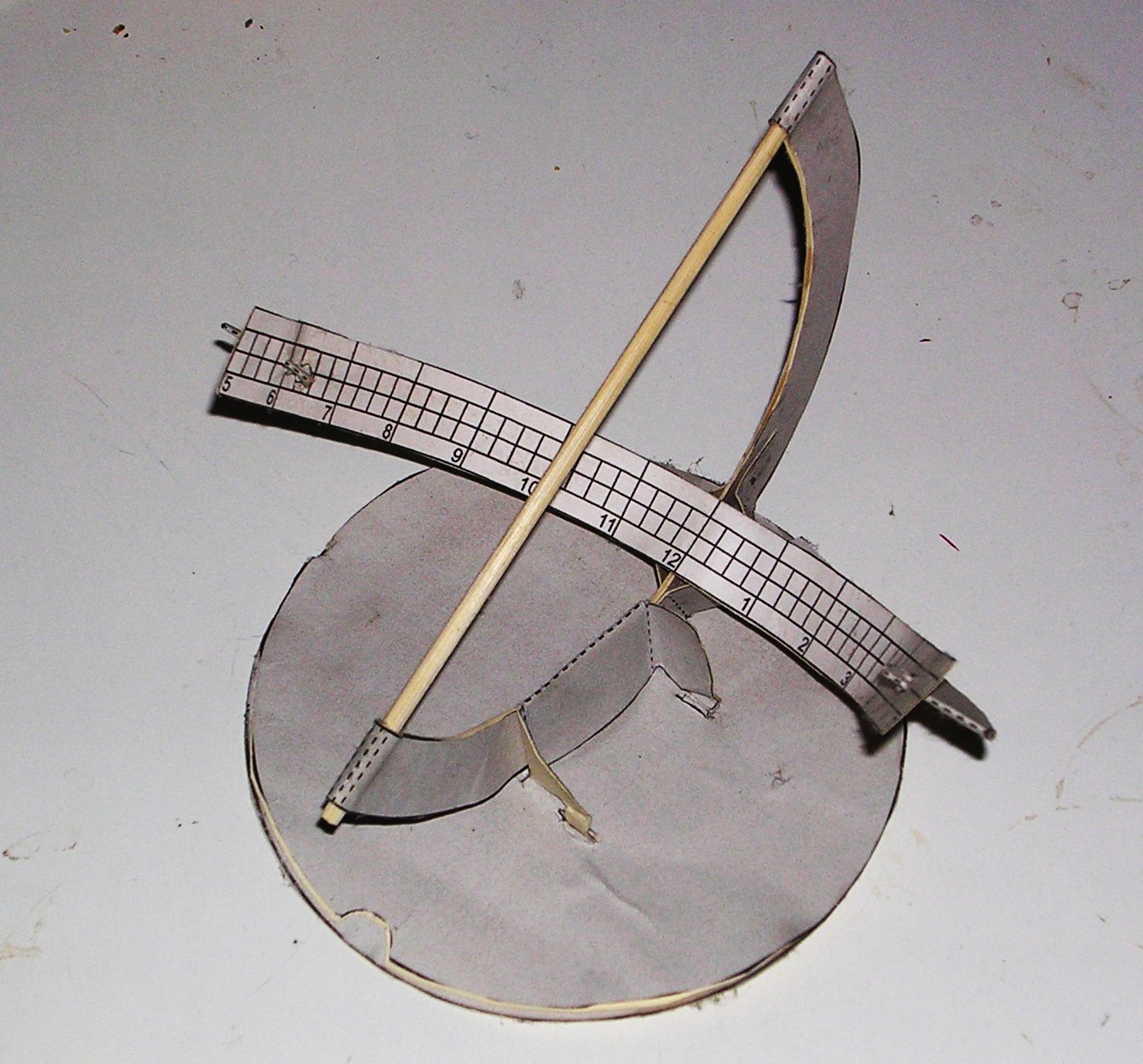
Equatorial Sundial
Overview
Construct a sundial that accurately tracks the sun and time throughout the year.
Background
People have used the sun to measure time for thousands of years. The movements of the Earth around the sun creates natural rhythms that dictate the day, lunar month, season and year. These are the natural units of time. On top of these we have imposed our own artificial units the second, minute, hour, week, calendar month and millennium. The need for measuring time has been driven by our day to day needs. Knowing seasons and dates helped farmers to decide when to plant. Lunar cycles helped us predict full moons. The winter and summer solstices marked important dates for pagan religious observation. Primitive peoples erected monuments and used natural alignments of rocks to mark the extremes of position of the sun in the sky. In Ireland the druid monument of Newgrange was a ceremonial center and solar observatory. A hallway passing into the center of the mound is aligned to mark the winter solstice. At dawn on December 20th sunlight passes all the way down the hall and castes a shadow on a spiral mark on the wall.
This is similar to the sun dagger spiral that is used by the Anasazi to mark the position of the sun. Primitive architecture is often aligned with the compass directions so that on equinox the sun rises along an east west facing wall.
Early people were also aware of the changing time of rising of star constellations. The mystical belief of astrology requires precise measurement of the rising times of each constellation.
Astronomy- Revolutions and Rotations
Sundials are using to count the hours of the day. The earth rotates 360 degrees in 24 hours, or 15 minutes per hour. This rotation is the basic driver of sundial time. The sun appears to move across 15 degrees of sky every hour. We say "appears to move" because we know that the sun actually stays put while the earth turns on its axis. From our point of view the sun rises in the east and sets in the west. The angle of the North Star is fixed in the sky and all of the stars appear to rotate around that static point. Over the course of a year the suns position with respect to the background of stars appears to move as we revolve around the sun. In winter the sun is lower on the horizon at noon. It rises south of east, and sets south of west. The angular speed of the sun is still 15 degrees per hour but it passes over a shorter arc from horizon to horizon resulting in fewer hours in the day. In summer the sun rises north of east and sets north of west. Depending on your latitude, the summer solstice sun may trace an arc of 240 degrees giving us a day length of 16 hours. At the same moment at the north pole the sun moves around in a 360 degree arc, parallel to the horizon and the day is 24 hours long.
Sundial History
The simplest sundial is object that casts a shadow ( a gnomon) and a radiating set of lines indicating the hours. Sundials are usually mounted to a solid stone pedestal so they can't be adjusted for daylight savings time. In the Middle Ages astronomers were fascinated by the organization of the heavens and they constructed 3 dimensional models known as armillaries. Some models had complex gear works that also attempted to explain the movement of the planets. This was especially complicated when people believed the earth was the center of the solar system. Later when we understood the sun is the center and that planets move in elliptical orbits around it the planetary movements became simpler. Early armillaries depicted the astrological symbols in an arc stretching around an axis that was inclined to point to the North Star. The equatorial sundial kit is fashioned after the armillary. The gnomon casts a shadow on a dial that is measured in units of 15 degrees.
Glossary
- Gnomon
- Degree
- Solstice
- Rotation
- RevolutionN
Standards
Materials
- Card stock that can be printed on your laserprinter
- Straight pins
- Corrugated cardboard
- glue
Instructions
Print out the two pages of the plans on good grade paper. If your printer can handle a thicker grade of card stock then use this.
- Glue the plans onto thicker card stock or a manila file folder. Spread glue on the whole back surface of the plans, this makes it stronger.
- Cut out the dial strip, support joiner, gnomon support ring and the dial strip support ring with scissors. Only cut the solid lines not the dotted lines. Use a sharp knife to start a cut on the upper and lower base inside the two rings and then finish the cut with scissors.
- Cut out the three center slits on the upper base with a knife. Cut out the folding base support.
- Fold dial support ring along the dotted lines and glue the inner surface to form a semi-circle.
- Make the gnomon by cutting a 7" length of 1/8" dowel or shish-ka-bob skewer.
- Fold the gnomon support ring along the dotted lines around the ends of the gnomon.
- Slide the gnomon support ring into the dial support ring.
- Fold the ring connector along the dotted lines and back around the slides. Slide this over the joint between the rings. Apply glue the triangular tabs and press this around the joint between the rings. Be sure they form a right angle.
- Press sundial strip over the tabs in the dial support ring. Arrange it so that the numbers are read right side up when the gnomon is facing north.
- Fold up the base support from the lower base and press it through the central slit in the upper base support. Fold the support above the angle viewing window and then fold back the support arms in the opposite direction.
- Place the portion of the gnomon support ring with angle measurements in the folding base support so that the angles are visible through the window.
- Slide the base support tabs through the short slits in the upper base and glue the whole lower base to the upper base.
- Glue the optional sun azimuth scale on the gnomon support ring so that it passes behind
How to use the equatorial sundial
Rotate the sundial on the base until the pointer shows the local latitude.
Orient the sundial on a flat surface so that the gnomon support ring points at true north. You can do this with a magnetic compass if you take into account the local declination. Another method is to align your sundial one time at high noon so that the shadow of the gnomon falls exactly centered on the "12" line.
Extensions
- Mount your sundial in a location that will be water proof but in the sun, under an overhang. Make marks on the dial to indicate how high the sun is at noon. On equinox make observations to prove that the sun rises due east and sets due west, and the day is exactly 12 hours. If your sundial is correctly adjusted for your latitude the noon sun should cast a shadow from the gnomon exactly in the center of the dial. Repeat these measurements for winter and summer soltices.
- Use the same plans but construct a sundial out of more durable materials such as plywood with a sheet metal dial.