Overview
[toc]
Despite all the negatives aspects of plastic pollution we know that plastic is still a very useful material. Plastic is durable, inexpensive, lightweight, and easily formed into useful objects. Plastic is an ideal packaging material and saves energy in transportation. There are a variety of bioplastics currently being explored by material scientists. Some are already being used.
Background
Corn starch plastic-
Corn starch is a white powder that is used as a thickening agent in cooking. Chemically it is a mixture of amylose and amylopectin in a ratio of about 1 part amylose and 4 parts amylopectin. Amylose is a simple chain of the sugar glucose. Amylopectin is a highly branched polymer of glucose. To make a flexible polymer we need long straight chains. Amylopectin can be converted into short molecules of dextrin by breaking its bonds with heat and an acid such as vinegar (acetic acid). Breaking bonds this way is called hydrolysis.
Other starches such as tapioca contain a higher percentage of dextrin making them a naturally a little more flexible.
Starch plastic often require an addition material such as oil or glycerin to keep it flexible, this is a plasticizer. The plasticizer works its way in between polymer chains and prevents them from bonding to each other too strongly.
Gelatin
Gelatin is a biopolymer made from animal proteins such as cartilage or hoofs. Gelatin powder is added to water and heated. Gelatin only thickens when it cools and will liquefy again when heated. By adding more gelatin powder and less water you can make a material almost like rubber.
Seaweed Plastic
Agar is a biopolymer (another polysaccharide) made from seaweeds such as the red alga Gelidium P7. Agar and other seaweed jells are used extensively in the food industry to emulsify and improve the consistency of foods. It sets up like gelatin and is used as a bacterial growth media in petri dishes.
Casein plastic
Milk contains a protein called casein. If milk is heated and then denatured with a mild acid the casein forms a plastic material by forming cross linkages. At first the material looks like milk curds. Upon drying it become rock hard earning it the name Galalith (milk stone). Galalith was widely used for making jewelry and buttons in the early part of the 20th century before petroleum based plastics were developed.
Polylactic Acid PLA
Sugars from starchy plants can be fermented with a certain bacteria to produce lactic acid. Lactic acid is purified and then polymerized to form polylactic acid or PLA P2. Finally the polylactic acid can be mixed with plasticizer and other chemicals to produce a resin that can be cast. PLA is currently being used to produce plastic utensils. The production process for this is complex and can’t be done in the kitchen.
More than 1 million tons of sugar beet pulp are generated annually by U.S. beet sugar industries. Sugar beet pulp can be mixed with polylactic acid to make a polymer similar to polystyrene or polypropylene. It is a thermoplasticP3 which makes it useful because it can be formed or cast when hot.
Cellulosic Plastic
One of the first plastics developed was called cellophane. It was made by treating cellulose with nitric acid forming nitrocellulose. Cellulose is a carbohydrate like starch, a polymer of sugar molecules. However cellulose has a different pattern of bonding than starch making it stronger and more durable. Nitrocellulose is extremely explosive and is not used today except in explosives. Chemists are looking for ways of converting cellulose from trees and agricultural waste into a safe bioplastic.
Instructions
Kitchen chemistry with biopolymers
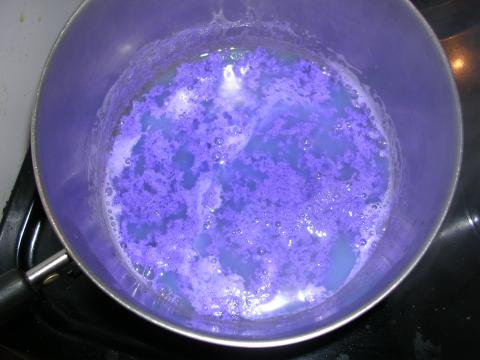
There are many starchy food stuffs that you can use to make your bioplastic. The process is basically the same for each. Mix the liquid with the powdered starches in a saucepan. Heat the mixture slowly on a stove stirring constantly with a spatula and scraping the bottom so nothing sticks. You can also heat a small amount in a bowl in the microwave, but frequent stirring is still required. Be sure to use a hot pad! As the starch absorbs water it will turn from a white chalky solution to a clear liquid or jelly.
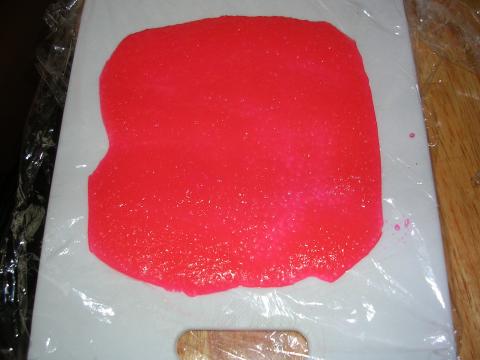
Turn out the blob of bioplastic on to a piece of plastic wrap which has been stretched out in a cookie sheet. Spread the blob out into a layer about ¼” thick with a spatula.
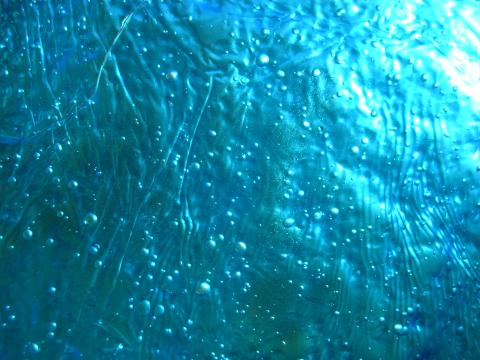
When the bioplastic dries it becomes a thin clear sheet.
Pure starch will be quite brittle so you need to add a plasticizer such as glycerin or canola oil to keep the plastic sheet flexible.
Hint: Glycerin can sometimes be hard to find, check the drug department where it may be sold as a skin moisturizer.
You can also try combinations of casein, glue, agar, gelatin and starch. Try to discover what effect each ingredient has on the properties of the material. When you have an idea then change your formula to get the perfect combination of properties. This may take a lot of experimental trials.
Bioplastic Recipes
Starch Polymer
- 2 tablespoons Cornstarch or tapioca
- ½ cup water
- 1 teaspoon glycerin
- 2 tablespoons white vinegar
- Food coloring
Polymer Clay
- 1 cup white glue
- 1 cup cornstarch
- 1 tsp. white vinegar or lemon juice
- 1 tsp. glycerin
Gelatin Polymer
- 3 tablespoons unflavored gelatin powder
- 1/4 cup water
- 1/2 teaspoon glycerin
Agar Polymer
- 1 tsp. agar
- ¾ cup water
- 1 tsp. glycerin
Silly Putty Polymer
This is another interesting material. You don’t have to heat it. The borax reacts with the glue to cause polymerization. The silly putty blob will bounce and drip. When it dries it starts out like rubber and then become brittle.
- White glue
- 2-3 tablespoons of borax (Na2B4O7) mixed in 1 gallon of water.
Materials Testing
Explore your bioplastic
Each time you make a sample pick it up and see how it behaves. Is it strong? How exactly is it strong? Is it brittle or stretchy? Did it retain the shape you wanted? How does it behave it get wet again? What happens if it is heated slightly in a microwave oven
Record on the spreadsheet how each sample behaves. Try bending it, stretching it, see what happens if it gets wet. Next we will try to be more quantitative in our materials testing.
Tensile strength is measure of the strength of a piece of a material as it is stretched. A rope with strength of 1000kg should be able to support that much weight before snapping.
Now you can test your plastic samples and record the results in a spreadsheet.
Making Stuff
Fabrication
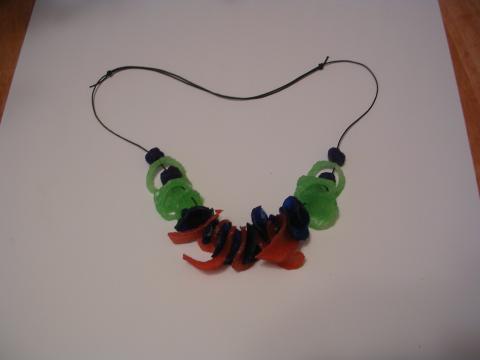
Now that you have developed a new material you must learn how to use it to make something useful. There are many manufacturing techniquesP11 you can explore with bioplastics. Next you must design a fishing lureP12 or plastic jewelryP13 that can be made out of the bioplastic you have developed.
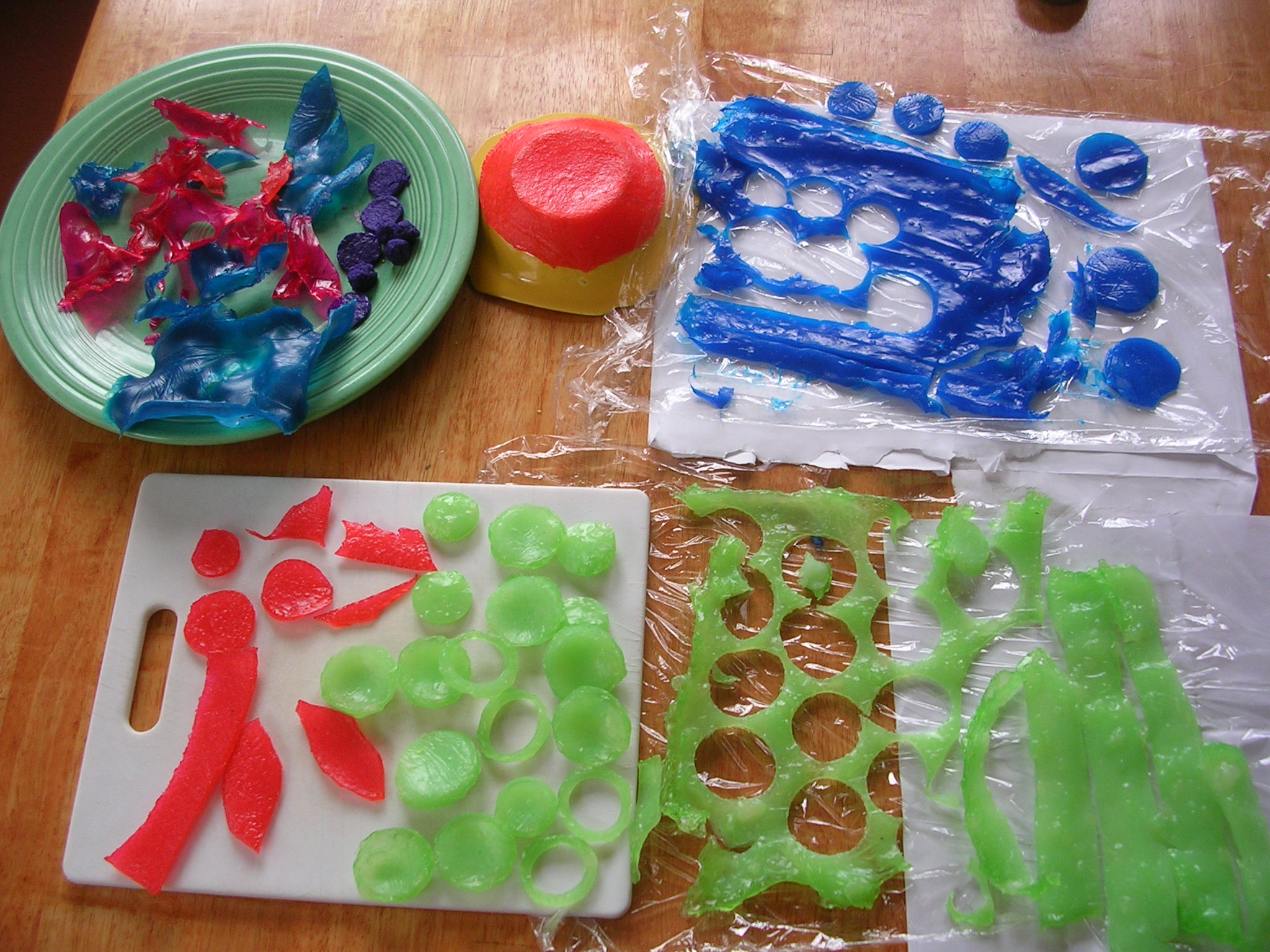
You may have discovered that some the films shrink and twist as they dry. You can form sheet cast films over a mold while they are still wet and flexible. After the plastic is completely dry it can be pried from the form and it will retain the shape of the form.
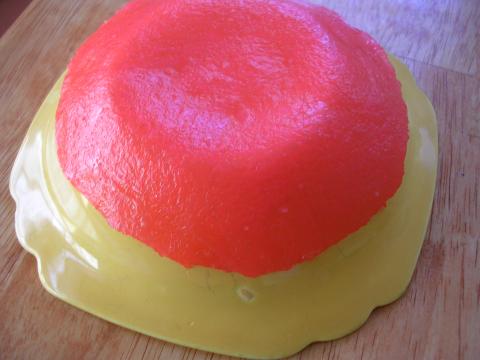
Some materials can be modeled while they are wet. Casein is best formed into its final shape while wet. As it dries the curds will bond to each other making it much stronger. Cookie cutters, lids or knifes can be used to cut out clean shapes from the sheets while they are partially wet. You may discover that some materials are easier to work with when they are dry as leather, while others need to be worked while still wet.
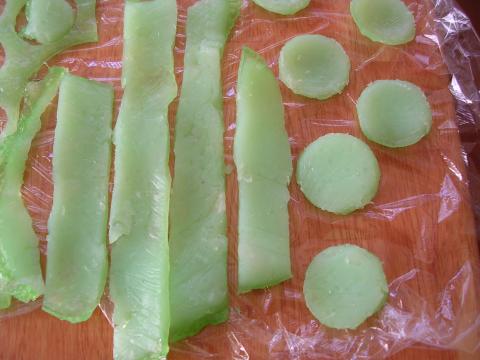
Thick objects can be cast into molds right after cooking. Gelatin is particularly good for this because it behaves thermoplastic which can be melted and solidifies as it cools. These cast shapes will take a long time to dry and will shrink as they lose their water. Some bioplastics contain a lot of water but it is tightly bound to the material and will not evaporate (think of gummy bears).
- Design and make some product with your bioplastic. Take photos to use in your presentation.